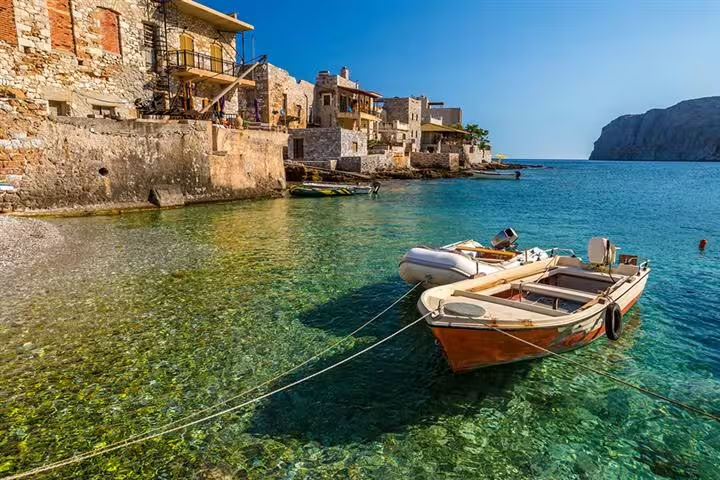
Mykonos combines high property values with a legal landscape that is harder than elsewhere in Greece. Much of the island lies outside approved town plans. Construction outside the plan has been under a permit suspension since 2023. The cadastral survey is still in its final stages, and many attractive properties sit close to the shoreline. None of this makes buying impossible. It means that, more than anywhere else, the checks have to be done before the deposit, not after.
Note: this guide reflects the position on 30 October 2026. Planning rules for Mykonos in particular are expected to change, and every property must be checked on its own documents.
First steps: tax number, representation, bank
A foreign buyer needs a Greek tax number (AFM) before signing, and usually a Greek bank account for the transaction payments. Many buyers sign through a lawyer under a power of attorney rather than travelling for each step. See our guide to the Greek AFM for non-residents.
Title: who really owns the property
Title review examines the seller’s chain of ownership in the registry records, back over a period sufficient to cover any claims that could still be raised. The lawyer looks for mortgages, seizures, pending lawsuits, easements and co-ownership. On Mykonos, inherited properties held by several family members, unregistered inheritances and old deeds with vague boundaries are common. Each requires its own solution before a transfer.
The Cadastre on Mykonos
Greece is replacing the old transcription registries with the Hellenic Cadastre. On Mykonos the cadastral survey was in its final stages in 2026. The Hellenic Cadastre announced the posting (ανάρτηση) of preliminary data for the Mykonos area of Ano Mera in March 2026, with a short window for corrections. Depending on the exact location, a buyer may need to check the operating Cadastre, the cadastral survey data, the old Land Registry books, or all of them.
Two practical points follow. First, the area recorded in the Cadastre, and the boundaries shown on the cadastral diagram, should match the title and the engineer’s survey. Discrepancies are best corrected before the contract. Second, a property registered in the seller’s name in the Cadastre is a strong starting point, but not a substitute for title review.
Planning status and illegal structures
For most transfers, Greek law requires an engineer’s certificate, uploaded to the Electronic Building Identity system (Ηλεκτρονική Ταυτότητα Κτιρίου), confirming that the building has no unauthorised structures or that any have been regularised. This is where many Mykonos deals slow down. Pools, extensions, roofed verandas and converted storerooms are frequent findings.
Not everything can be legalised. Law 4495/2017 allows certain unauthorised constructions to be regularised on payment of a fine, but excludes others, depending on their location and type. The buyer’s engineer should be independent of the seller and should compare the building on site with the permit drawings, not only with the seller’s certificate.
Building on Mykonos: the out-of-plan permit suspension
Buyers planning to build or extend should know that the issuing of building permits in out-of-plan areas of Mykonos has been suspended since 2023 under Article 270 of Law 5037/2023. Law 5261/2025 extended the suspension until the approval of the island’s Special Urban Plan (Ειδικό Πολεοδομικό Σχέδιο), and in any case not beyond 31 December 2026. At the time of writing the plan had not been approved. A plot bought “to build a villa” may therefore not be buildable on the terms the seller describes, and the rules that will apply after the suspension depend on the plan’s final content.
The shoreline: αιγιαλός and παραλία
Under Law 2971/2001 the foreshore (αιγιαλός) and the beach zone (παραλία) are public property for common use, owned by the State. No buildings may be erected there, and where a private property lies between a public road and the shore, free access to the shore must be ensured. The former foreshore also belongs to the State. For seafront properties, the buyer should confirm whether the foreshore line has been officially determined at that location and where the property’s boundaries lie in relation to it. A private buyer cannot acquire rights over the foreshore, whatever older deeds may describe.
Other constraints
- Forest and archaeological status. Land characterised as forest, or falling within an archaeological zone, carries restrictions on use and building. Forest maps and archaeological services should be consulted where relevant.
- Border-area rules. Mykonos is not among the areas listed as border areas under Article 24 of Law 1892/1990, so the special acquisition permit required in those areas does not apply. Some other Cyclades islands, such as Santorini (Thira), are listed.
Renting out: short-term letting and the Golden Visa
Short-term letting through platforms requires registration with the Greek tax authority and a property registration number (ΑΜΑ). Since 1 October 2025, Law 5170/2025 has also imposed safety, insurance and equipment requirements, with fines for non-compliance. The new-registration freeze currently in force covers central Athens and central Thessaloniki, not Mykonos.
If the purchase is intended to support a Greek Golden Visa, different rules apply. According to the Ministry’s official guidance, the minimum investment on Mykonos is €800,000, the same as in Attica, Thessaloniki, Santorini and islands with more than 3,100 inhabitants. Properties acquired for the Golden Visa may not be let short-term through digital platforms. A 2026 ministerial circular, as reported, clarified that the threshold must be met in a single property of at least 120 m² of main area, and that long-term leases or leases to tourism businesses remain possible. See our guide to Golden Visa investment thresholds.
Contract, notary and costs
Property transfers in Greece are executed before a Greek notary, who drafts the deed and checks the documents the law requires for the transfer. The notary does not act for the buyer. The buyer’s own lawyer reviews title, negotiates terms and protects the buyer’s position. For larger transactions, a preliminary agreement with conditions (title, permits, Cadastre corrections) and a deposit is common.
The buyer should budget for:
- property transfer tax or, for certain new buildings, VAT, depending on the property;
- notary fees, lawyer’s fees and Cadastre or Land Registry registration fees;
- engineer’s fees for the building certificate and survey;
- after purchase, the annual property tax (ΕΝΦΙΑ) and income tax on any rental income.
Rates depend on the property and the transaction, and should be confirmed for the specific case.
A practical checklist
- Obtain an AFM and appoint a lawyer and an independent engineer.
- Review title, encumbrances and Cadastre data.
- Have the building surveyed against its permits; identify what can and cannot be legalised.
- Check the foreshore, forest and archaeological position.
- If building is planned, confirm whether permits can currently be issued.
- Align the purchase with your intended use (own use, short-term letting, Golden Visa).
- Only then sign a preliminary agreement, with conditions that protect your deposit.
Our general guide to legal due diligence when buying property in Greece explains the process in more detail. Articles are written by Konstantinos Tsegas, a lawyer admitted before the Supreme Court of Greece.
Frequently asked questions
Can foreigners buy property in Mykonos?
Yes. Mykonos is not listed as a border area under Article 24 of Law 1892/1990, so the special acquisition permit required in those areas does not apply. A Greek tax number (AFM) is needed before signing.
Can I get a building permit for a plot outside the town plan in Mykonos?
Issuing of out-of-plan building permits on Mykonos has been suspended since 2023. Law 5261/2025 extended the suspension until approval of the island’s Special Urban Plan and not beyond 31 December 2026. Check the current position before buying land to build.
What is the minimum Golden Visa investment in Mykonos?
According to the Ministry’s official guidance, €800,000. A 2026 circular, as reported, requires the amount in a single property of at least 120 m² of main area. Golden Visa properties may not be let short-term through platforms.
Can I buy a property on the beach?
The foreshore and beach zone are public property under Law 2971/2001 and cannot be built on or acquired privately. Seafront plots need to be checked against the officially determined foreshore line.
Who checks the title, the notary or my lawyer?
The notary executes the deed and checks the documents required by law for the transfer, but does not represent the buyer. Title, encumbrances and terms are reviewed by the buyer’s own lawyer.
Considering a property in Mykonos?
We review title, Cadastre and planning documents with your engineer before you commit a deposit. Contact us with the property details to discuss a due diligence review.